Cart (0)
Your cart is empty.
July 22, 2026
By Brian G
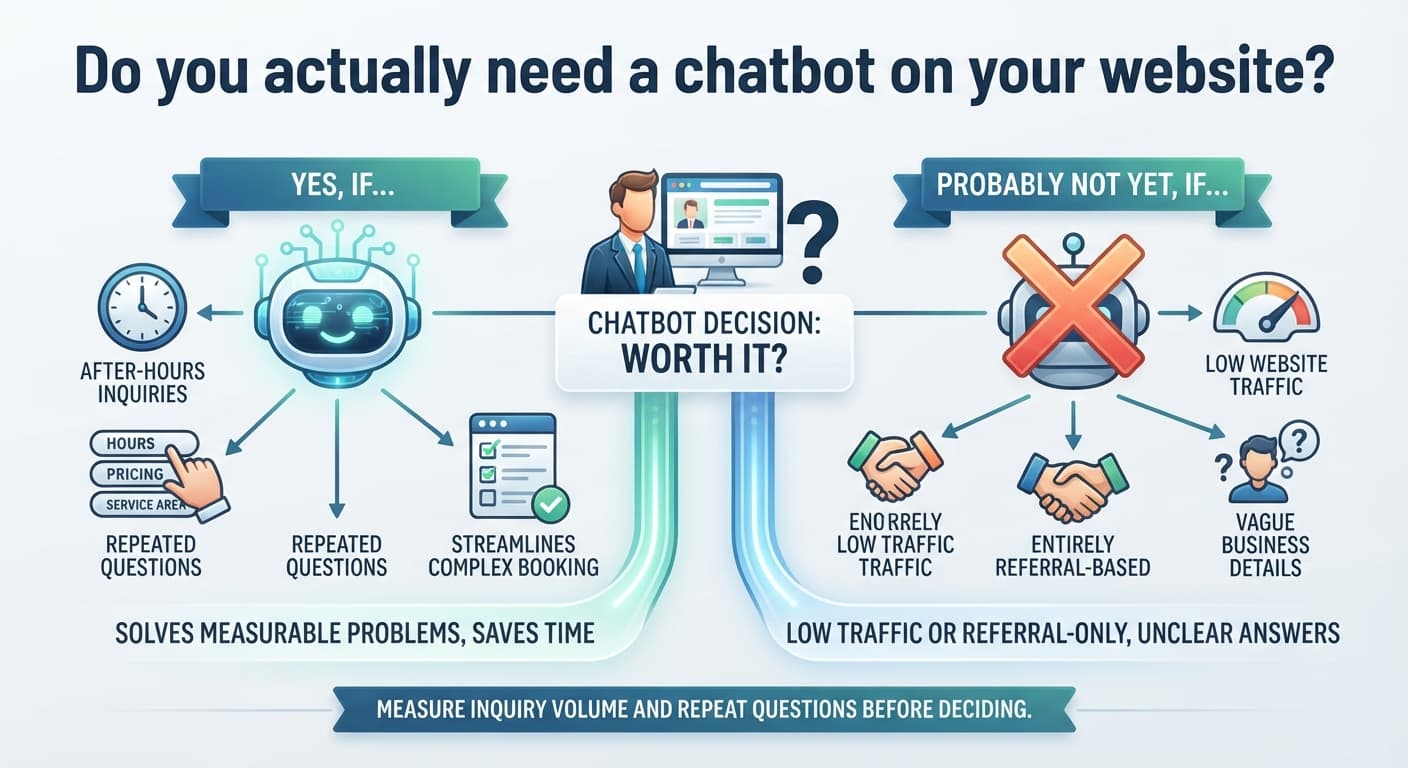
Chatbots get pitched to every small business right now, whether or not they're actually a good fit. Here's a simpler way to decide than taking a sales pitch at face value.
A chatbot is worth it if: you get inquiries outside business hours, you field the same handful of questions repeatedly (hours, pricing, service area, availability), or your booking process has enough steps that a visitor might bounce before finishing a contact form.
A chatbot is probably not worth it yet if: your site gets low traffic, your business is entirely referral-based with little cold website traffic, or you don't yet have clear answers to the questions it would need to handle — a chatbot trained on vague information just produces vague, unhelpful answers.
A quick way to test the theory before committing: track how many inquiries come in outside business hours over a month, and note how many times you or your team answer the same handful of questions on the phone. If those numbers are meaningfully high, a chatbot is solving a real, measured problem rather than a hypothetical one.
If you're not ready for a full chatbot, a simpler middle step is a well-written FAQ page that actually answers the specific questions customers ask — often the honest answer is that most of a chatbot's value can be captured with a good FAQ page and a clear contact form first.
If you do add one, the bar we hold ourselves to is simple: it identifies itself as AI immediately, it's trained on your actual business details rather than a generic script, and it hands off to a real person or a booking link the moment a question goes beyond what it should be answering. That's covered in more detail on our AI chatbots service page and our AI disclosure page.