Cart (0)
Your cart is empty.
July 22, 2026
By Brian G
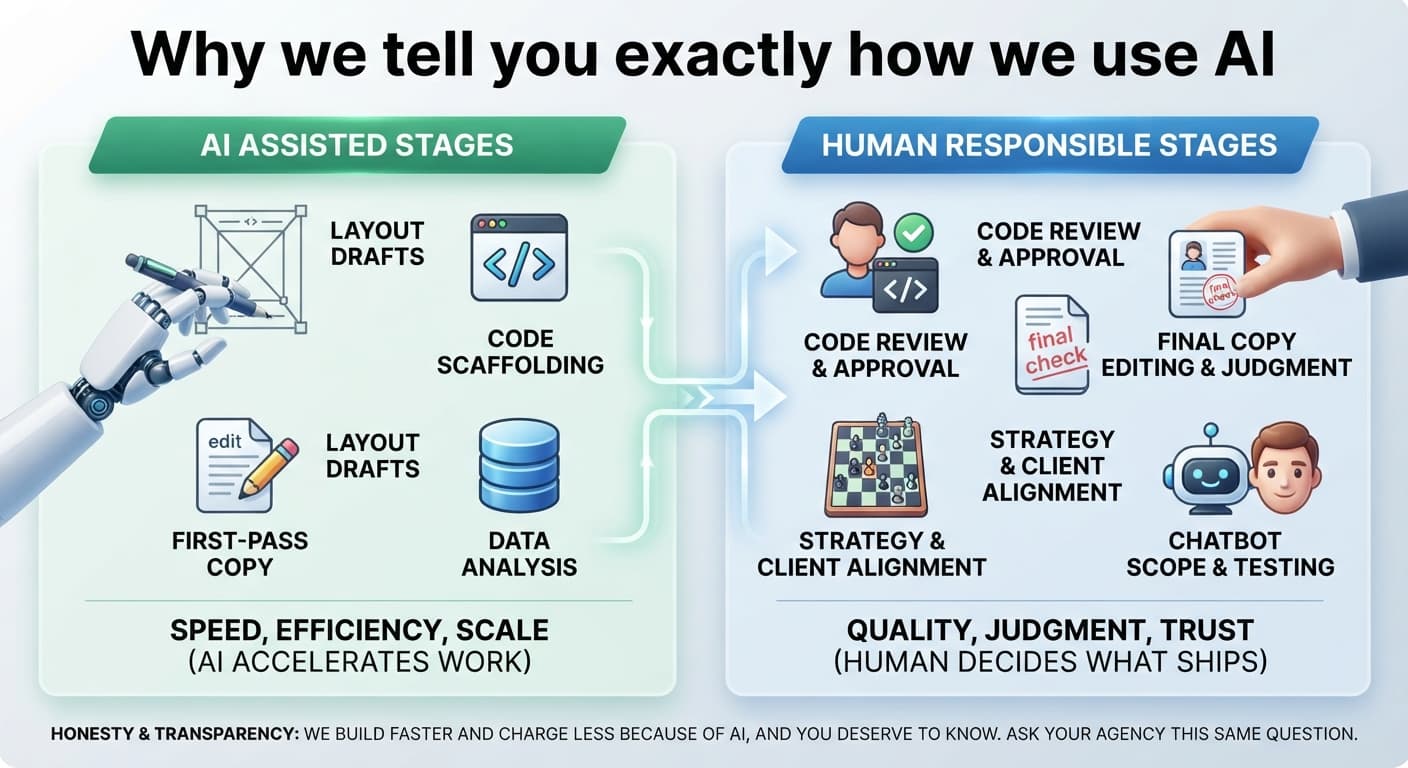
Every web design agency we've looked at in the last year uses AI tools somewhere in their process — for copy drafts, code scaffolding, image generation, or all three. Almost none of them say so on their website.
We think that's backwards. If a tool makes our work faster or better, the honest move is to say where it shows up, not to quietly bill you the same rate a fully-manual shop would charge and hope you don't ask.
So our AI disclosure page isn't a legal CYA buried in a footer link. It's a real breakdown, by area — website code, chatbots, blog writing, SEO — of exactly where AI assists and where a human is still the one deciding what ships.
The tradeoff we're making is trust for speed: we can build faster and charge less than a traditional agency because AI genuinely helps us move quicker. In exchange, we think you deserve to know that, plainly, instead of discovering it later.
If you've read a chatbot conversation on a small business site and wondered whether you were talking to a real person, that instinct is worth listening to — and it's exactly why every chatbot we build identifies itself as AI up front.
If you're evaluating any agency — not just us — a fair question to ask directly is: "Where exactly does AI show up in your process, and what does a human check before it ships?" A vague answer, or obvious discomfort with the question, is itself useful information.
Some signs an agency is using AI responsibly: they can name specific stages (drafting, not final review), they still charge for the judgment and revisions that come after a draft, and they're willing to put it in writing rather than only mentioning it if asked directly.
Some signs to be more careful about: an agency that avoids the topic entirely, one that markets itself as "AI-powered" without explaining what that means operationally, or one whose pricing doesn't seem to reflect any of the efficiency AI is supposedly giving them.